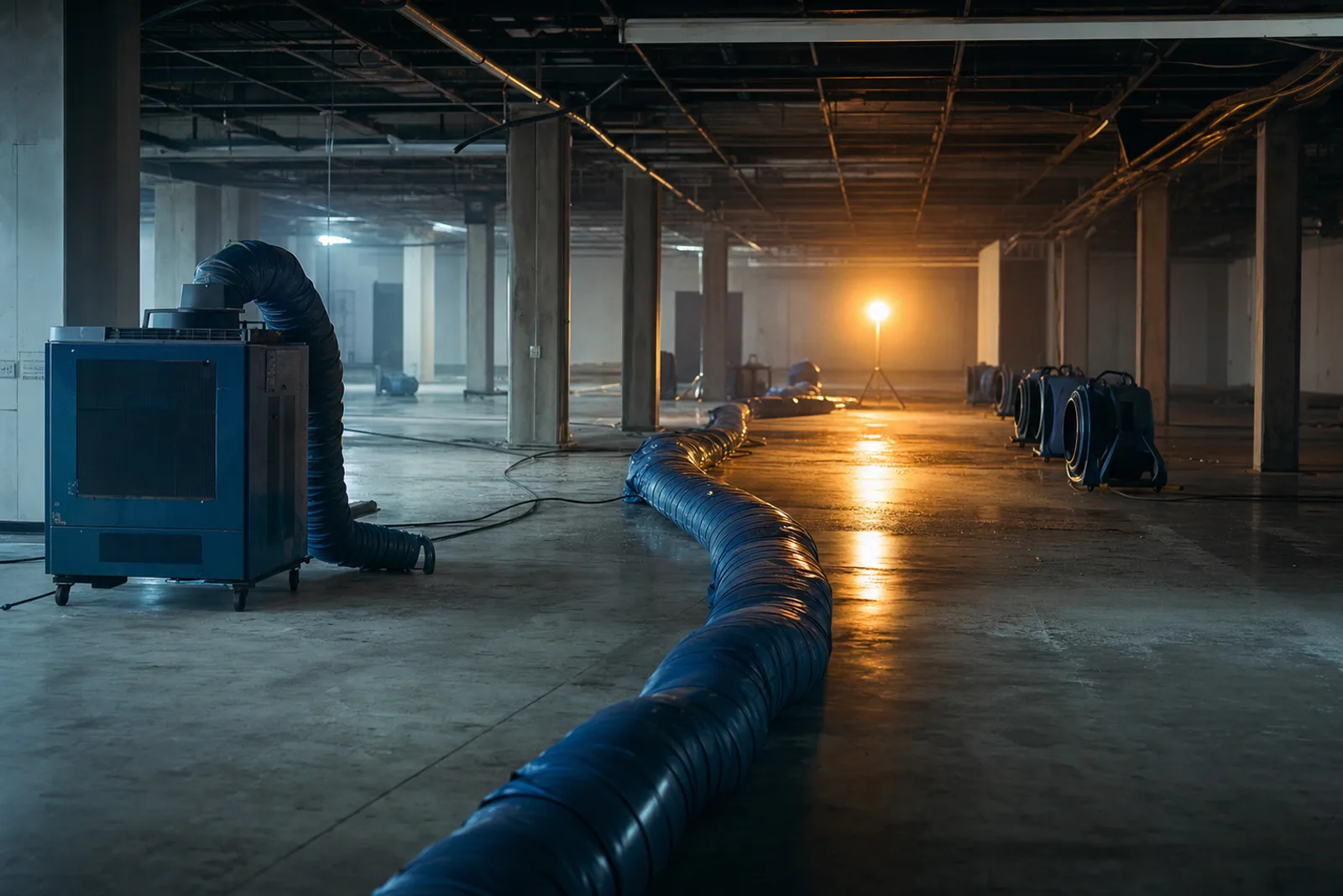
Lay-flat ducting running from an industrial desiccant dehumidifier across the floor of a large empty commercial building at night, with air movers lined up along the wall

Nationwide · Restoration training & consulting

Your Catalyst
For Growth

Commercial drying is not residential drying with more fans. Catalyst Training helps residential restoration operators build the technical judgment, equipment strategy and paperwork discipline that commercial losses demand.

Instructor approval in process — join the list and you'll be first to get cohort dates. Consulting is available today.

Course length
5 days
Instruction
32 hours
Standard
ANSI/IICRC S500
IICRC exam fee
$65

The gap

The first commercial loss is where residential habits break

You have run hundreds of houses. Then a 60,000 square foot facility floods, the building has its own air handling logic, the electrical service will not carry what you need to plug in, and the property manager wants a drying plan with numbers in it before anyone mobilizes.

Nothing about that job is a bigger version of a basement. The structure behaves differently, the psychrometrics are less forgiving, the equipment is heavier and needs to be sized rather than guessed, and documentation is the deliverable the client actually reads.

That is the gap Catalyst Training exists to close — with certification training built on the ANSI/IICRC S500 standard, and with per-project consulting for the jobs you are bidding or running right now.
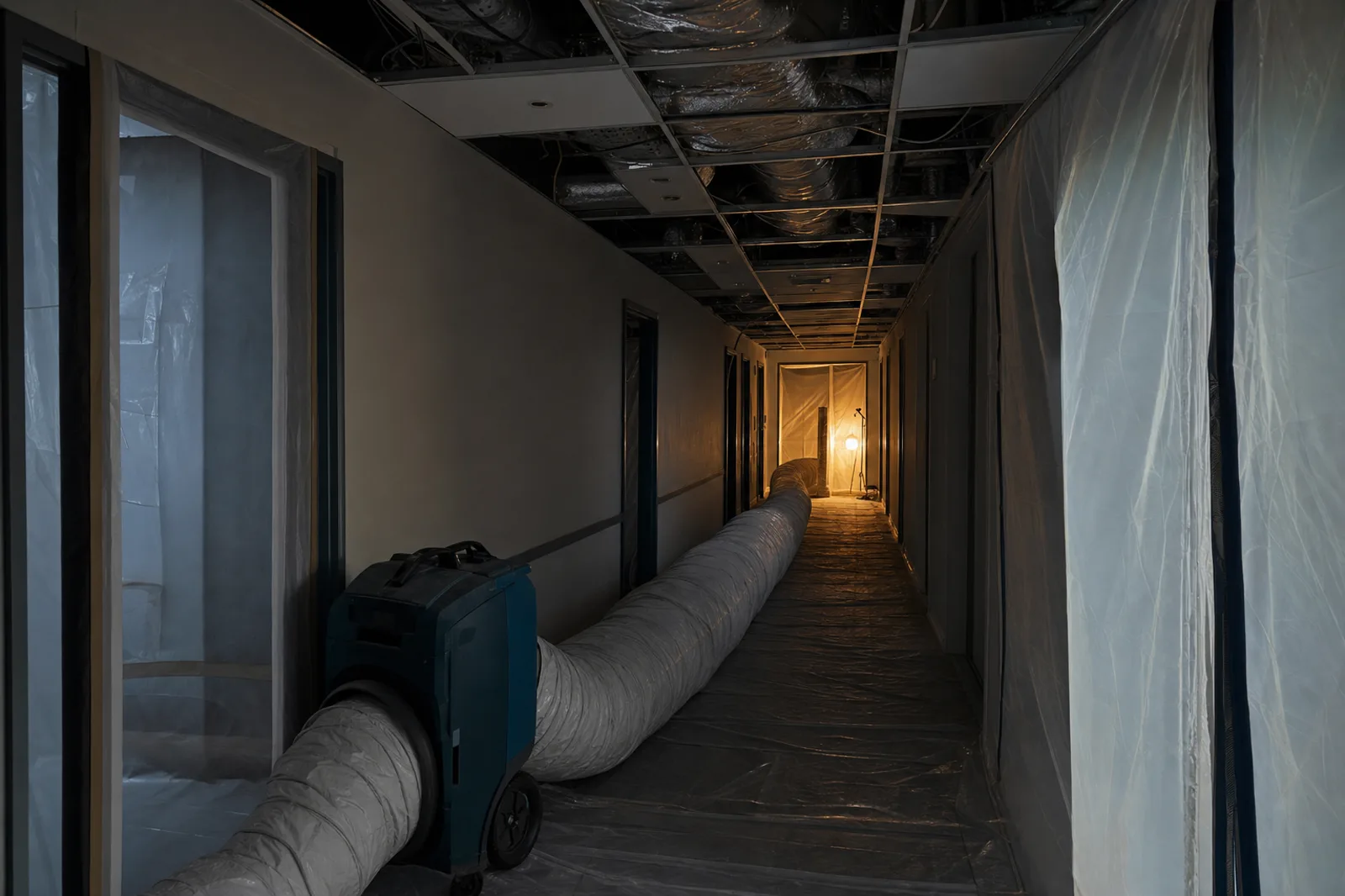
A hotel corridor mid-restoration with containment sheeting, exposed HVAC ductwork above removed ceiling tiles, and lay-flat duct running the length of the hall
Commercial structures bring HVAC interaction, containment and access constraints residential work rarely does.

The certification

What Commercial Drying Specialist covers

CDS is an IICRC certification. It demonstrates expertise in damage inspection and evaluation, workflow management, process administration, and the technical methods of effective and timely drying — applied to commercial, industrial, institutional and complex residential water-damaged structures, systems and FFE (furniture, fixtures, equipment).

Format
5 days, 32 hours of instruction, plus exam and break time
Prerequisite
IICRC WRT certification. OSHA-10 and HST strongly advised
Exam fee
$65, paid directly to the IICRC on the final day before the certificate issues
Curriculum basis
Drawn from the ANSI/IICRC S500 standard
Intended for
The experienced technician, project manager, estimator, or owner/manager
Cohort status
Forming now — dates to be announced

The people who need this class are already doing the work. They just have not been handed the framework yet.Who the class is for

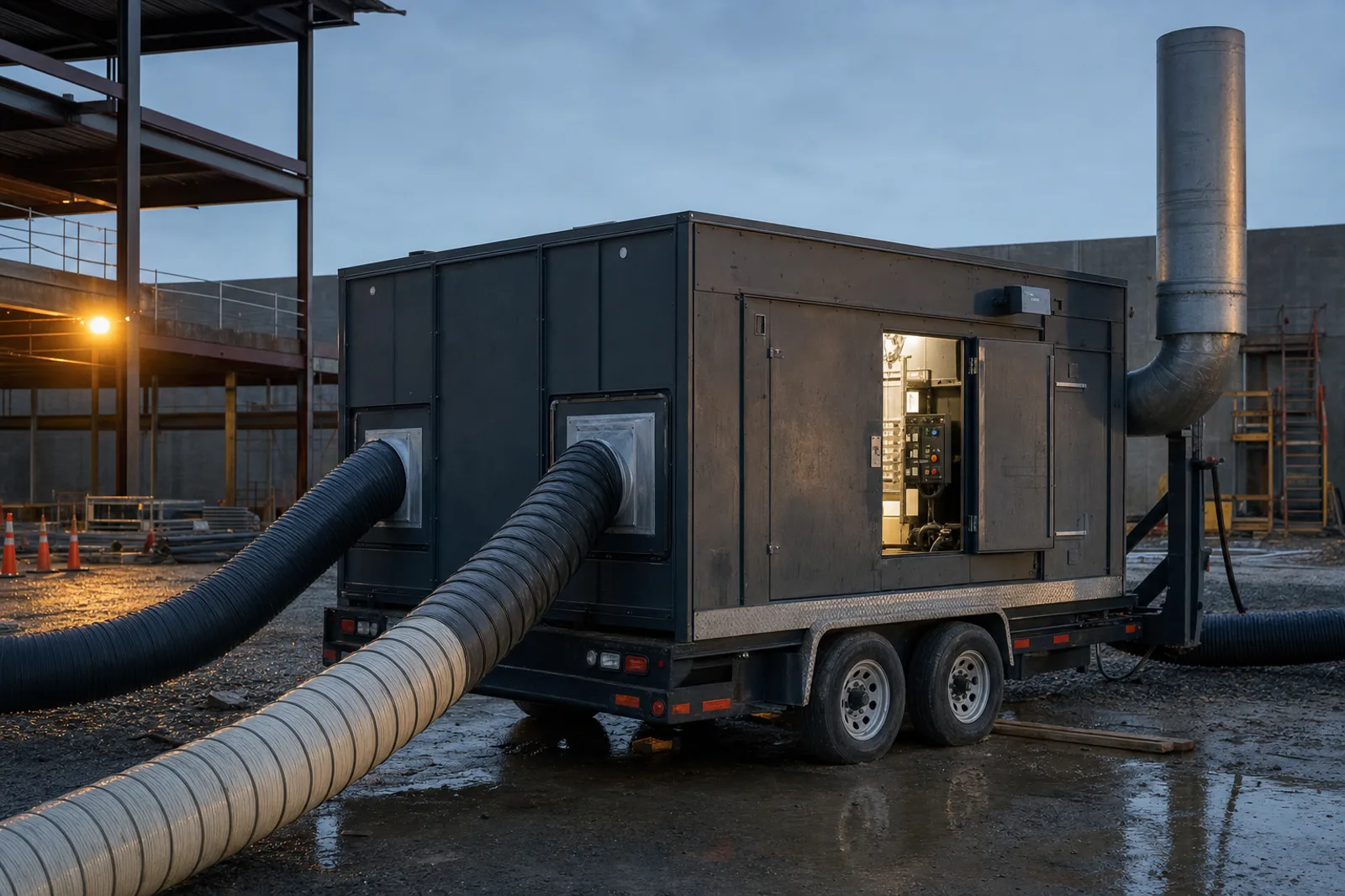
A diesel-fired desiccant dehumidification trailer on a commercial jobsite at dusk with process and reactivation ducts connected and wet exhaust routed outside
Dri-Max 6005 diesel desiccant trailer — used as a hands-on teaching aid.

Why here

Taught by an owner-operator who builds the equipment

Parker Olsen has spent more than ten years in restoration as an owner-operator, not as a career classroom instructor. He designs and builds his own commercial dehumidification and power equipment, and he runs the commercial jobs that equipment goes on.

That means adsorption, reactivation, process and reactivation airflow, wet-exhaust routing and grain depression get taught off real machinery rather than a slide.

  • 01

    25-ton LGR desiccant preconditioner

    Custom-built. Preconditioning strategy, staging and sizing explained by the person who specified it.

  • 02

    5,000 CFM HEPA prefilter systems

    Filtration and airflow budgeting on large-volume work, where CFM math stops being optional.

  • 03

    PLC-controlled generator load balancing

    Temporary power generation and distribution — a curriculum topic and a daily reality on commercial sites.

  • 04

    Atmos: equipment, consulting, remote monitoring

    Parker also runs Atmos, a contractor-support business that supplies and troubleshoots commercial jobs.

Read Parker's full background

Two offerings

Training for the next job. Consulting for this one.

Forming now · dates TBA

IICRC CDS training

Five days, 32 hours, built on ANSI/IICRC S500. Psychrometrics and moisture mechanics, equipment sizing, HVAC systems, temporary power, documentation, negotiation, health and safety, and drying complex structures — with case scenarios.

WRT is a prerequisite. The IICRC exam fee is $65, paid directly to the IICRC.

Available today

Commercial project consulting

Per-project advisory for contractors who have landed — or are bidding — commercial work. Scoping, drying strategy, equipment selection and sizing, temporary power and distribution, documentation, and project planning.

Useful before you price the job, and useful at hour 40 when the structure is not drying.

Status: instructor approval in process

Parker Olsen has applied for IICRC Approved Instructor status in Commercial Drying Specialist and approval is pending. Until it is granted, no CDS class can be scheduled and Catalyst Training makes no claim to be an approved or accredited school. The waitlist is how you find out first — it costs nothing and commits you to nothing. Consulting is unaffected and available today.

FAQ

Straight answers

Certification facts here come from the IICRC and from published CDS course listings. Anything Catalyst Training has not decided yet is described as not decided yet.

IICRC CDS certification page ↗

What is the IICRC Commercial Drying Specialist (CDS) certification?

CDS demonstrates expertise in damage inspection and evaluation, workflow management, process administration, and the technical methods of effective and timely drying. It applies to commercial, industrial, institutional and complex residential water-damaged structures, systems and FFE — furniture, fixtures and equipment.

Who is the CDS class intended for?

The IICRC describes CDS as intended for the experienced technician, project manager, estimator or owner/manager. In practice it suits residential restoration operators who are moving into commercial losses.

Do I need a prerequisite before taking CDS?

Yes. IICRC WRT (Water Damage Restoration Technician) certification is a prerequisite. OSHA-10 and HST are strongly advised.

How long is the course and what does it cost?

The course is five days — 32 hours of instruction — plus exam and break time. The IICRC exam fee is $65, paid directly to the IICRC on the final day before the certificate issues. Catalyst Training has not set tuition yet; pricing will be published with the first cohort dates.

When is the first cohort?

Dates are not announced. Parker Olsen's application for IICRC Approved Instructor status in CDS is pending, and no class can be scheduled until that is resolved. Everyone on the waitlist is contacted first when dates are set.

Can I get help on a commercial job right now?

Yes. Consulting is available today and does not depend on the training approval. That covers scoping, drying strategy, equipment selection and sizing, temporary power and distribution, documentation and project planning.

Two ways to start

Get in line for the first CDS cohort, or bring in help on the commercial job you are looking at right now.